How Much Does It Really Cost to Own a Home in Costa Rica? The Expenses Foreign Buyers Often Underestimate

Buying a home in Costa Rica has a way of making otherwise disciplined people temporarily forget about spreadsheets.
It is understandable.
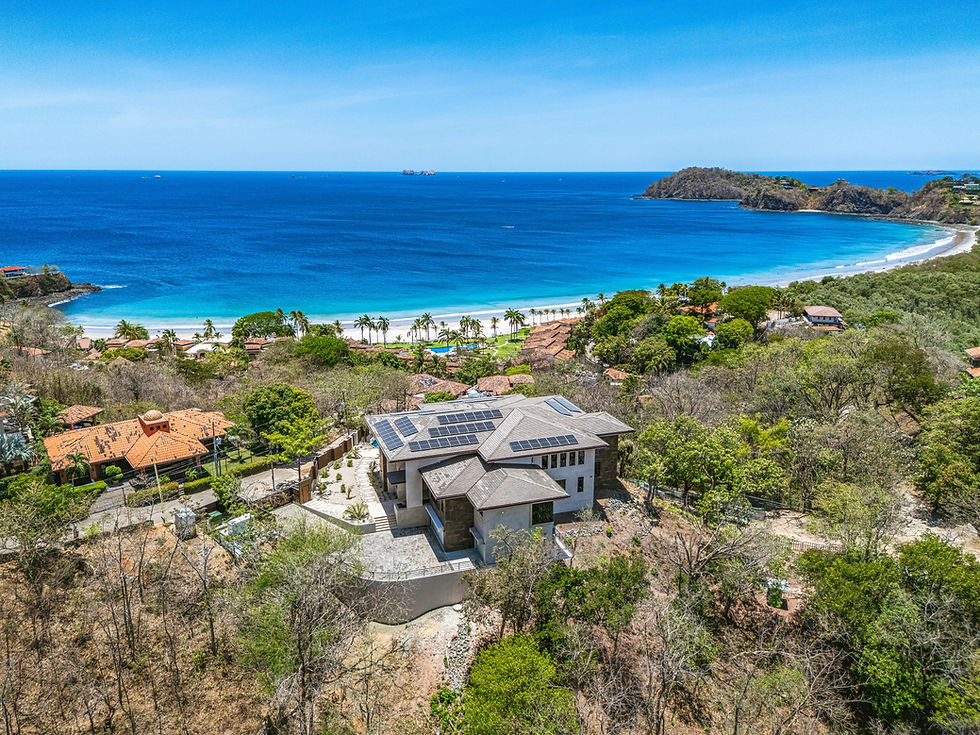
You arrive at a house on a hillside above the Pacific, walk through a wall of sliding glass doors and find yourself standing beside an infinity pool at four o'clock in the afternoon. Below you, fishing boats move slowly across the bay. The temperature has begun to fall. Someone mentions that the beach is seven minutes away.

At that particular moment, nobody is thinking about the lifespan of an air-conditioning compressor.
They are not thinking about HOA reserves, pool pumps, salt corrosion or the cost of repainting an exterior wall after several years of tropical sun.
They are thinking: What would it take to make this mine?
For foreign buyers, that question usually leads to another number: the purchase price.
A condominium costs $350,000. A house costs $750,000. An ocean-view villa costs $1.5 million.
Those numbers are easy to understand because they appear on the listing.
The more revealing number is the one that rarely does:
What will this property cost to own every year after the closing?
That question deserves considerably more attention than it receives.
The annual cost of owning a home in Costa Rica can be surprisingly reasonable in some respects. Property taxation, for example, is generally modest compared with many North American jurisdictions. But tropical homes have their own economics, and the expenses that matter most are not always the ones foreign buyers expect.
After years of watching international buyers settle into life in Guanacaste, I have found that the happiest owners are rarely those who found the absolute cheapest property.
They are the ones who understood the economics of the property they purchased.
Because there is an important difference between being able to buy a house in Costa Rica and being comfortable owning one.
The Purchase Price Is Only the Admission Price
Real estate buyers everywhere understand, at least intellectually, that a house continues to cost money after closing.
What changes in Costa Rica is the composition of those costs.
A buyer arriving from Toronto might be accustomed to substantial annual property taxes but relatively predictable exterior maintenance. Someone coming from a condominium in New York may have barely thought about roofs, swimming pools or landscaping because those expenses disappeared into a monthly building charge.
A house in Guanacaste rearranges the equation.
Property tax may feel refreshingly modest.
Then the house introduces you to everything else.
There is a pool.
A garden.
Five air conditioners.
An irrigation system.
A gate motor.
A water pump.
Perhaps a retaining wall.
Maybe a septic system.
Possibly a backup water tank.
And because this is Costa Rica, much of it operates in a climate where sunshine, humidity, rain and salt air work continuously on anything humans have constructed.
This does not make ownership prohibitively expensive.
It makes budgeting important.
Costa Rica's Property Tax Is Often the Pleasant Surprise
For many foreign buyers, one of the more attractive aspects of owning property in Costa Rica is the ordinary municipal property tax.
Costa Rica's property tax framework applies a 0.25 percent annual rate to the registered value of real property.
For someone arriving from a North American city where annual property taxes can amount to tens of thousands of dollars on a valuable home, that can be striking.
But there is an important distinction between the property's purchase price and the value used for tax purposes, and owners have obligations concerning declarations and municipal records. The exact amount for a particular property should therefore be verified rather than estimated casually from the listing price.
Certain higher-value residential properties may also fall within Costa Rica's separate solidarity tax regime for luxury homes, depending on the taxable value of the construction and applicable thresholds.
The broader point remains: property tax is often not the expense that surprises foreign owners.
Maintenance is.
The Ocean Is Beautiful. It Is Also Relentless.
Anyone considering Guanacaste real estate should understand something about living near salt water.
The ocean does not need to touch your house to affect it.
Salt travels through the air.
It settles on metal fixtures, railings, outdoor appliances, door hardware and air-conditioning components. Add heat, ultraviolet exposure and seasonal humidity, and materials age differently than they do in a dry inland climate.
A stainless-steel refrigerator that might look nearly new after ten years elsewhere may tell a different story near the Pacific.
Exterior paint fades.
Metal oxidizes.
Outdoor furniture deteriorates.
Wood requires attention.
Seals around windows and doors age.
Electronic components can suffer.
None of this is particularly dramatic on any given Tuesday.
That is precisely why buyers underestimate it.
Coastal deterioration usually arrives not as a catastrophe but as a thousand small acts of maintenance.
A hinge.
A light fixture.
A pool component.
An AC service.
A section of paint.
A piece of outdoor furniture.
Over a year, each seems insignificant.
Over ten years, they become part of the economics of the property.
This is one reason I encourage buyers to look beyond architectural beauty and ask what materials were actually used.
A house designed intelligently for the tropics can be substantially easier to own than one that merely photographs well.
Air Conditioning Has a Life of Its Own
Most modern homes and condominiums along the Guanacaste coast rely heavily on mini-split air-conditioning systems.
They are efficient and practical.
They also require maintenance.
A two-bedroom condo may have three units.
A large villa may have six, eight or more.
Now imagine servicing and eventually replacing them over the ownership period.
A foreign buyer who looks only at the monthly electricity bill misses part of the cost. The equipment itself is a depreciating component of the home.
This is true of virtually every mechanical system.
Pool pumps eventually fail.
Water heaters need replacing.
Refrigerators stop cooling.
Washing machines encounter their final load.
The larger and more luxurious the property, the more systems it generally contains.
Luxury does not merely increase the purchase price.
It increases the number of things that can require maintenance.
The Swimming Pool Is Not Free After You Buy It
Few features sell Costa Rica real estate more effectively than a swimming pool.
And for good reason.
In Guanacaste, a pool can become an extension of the living room. It is where families spend afternoons, where rental guests congregate and where some of the most memorable photographs of a property are taken.
But pools require continuous attention.
Water chemistry must be managed. Pumps and filters operate regularly. Surfaces eventually need work. Leaves do not care whether the owner is in the country.
If the home is rented, the standard becomes even higher.
A homeowner may tolerate a few leaves after a windy night.
A vacation guest paying several hundred dollars per night will not.
That distinction is important because the economics of a personal residence and the economics of a luxury vacation rental are different.
Rental properties are expected to be ready all the time.
That readiness costs money.
The Garden Grows When You Are Not Looking
The same principle applies to landscaping.
Costa Rica's green season can transform a dry hillside with extraordinary speed.
It is one of the country's great pleasures.
It is also why a tropical garden cannot simply be landscaped once and forgotten.
Trees grow.
Palms shed.
Hedges expand.
Irrigation systems require maintenance during the dry months.
Vegetation can interfere with roofs, drainage and ocean views if left unattended.
A large landscaped property may require regular gardening staff. A condominium, by contrast, may incorporate landscaping into its HOA fee.
Neither arrangement is inherently cheaper.
One is simply visible as a direct expense while the other is bundled into a community charge.
HOA Fees: Don't Ask Only How Much
This is where Costa Rica HOA fees become interesting.
Foreign buyers often ask me immediately:
"How much is the HOA?"
It is a reasonable question.
It is not the most important one.
The better question is:
What does the HOA buy me?
Imagine two communities.
Community A charges $250 per month.
Community B charges $700.
At first glance, A appears dramatically cheaper.
But suppose Community B includes 24-hour security, landscaping, common-area insurance, road maintenance, multiple pools, a gym and extensive infrastructure reserves.
Meanwhile, Community A's low fee covers little and the association has inadequate reserves for a major road repair approaching in three years.
Which community is cheaper?
The answer is no longer obvious.
Low HOA fees can be excellent.
They can also indicate that a community is postponing expenses rather than avoiding them.
A well-funded association effectively forces owners to save collectively for infrastructure.
A poorly funded one may eventually send them a special assessment.
For an investor, HOA rules also have economic value. A community that maintains architectural standards, security and common areas well can support resale values.
The monthly charge is only one side of the ledger.
Insurance Is a Conversation, Not a Checkbox
Foreign buyers sometimes assume that homeowners insurance works exactly as it does in their home country.
It is better to investigate the specific property.
Coverage requirements and premiums vary according to the building, location, value and risks being insured.
A condominium may already carry certain insurance through its association while the owner needs additional coverage for interiors, contents or liability.
A freestanding luxury home presents a different situation.
If the property will operate as a vacation rental, that use should also be discussed with the insurance provider rather than assumed to be covered under an ordinary residential policy.
The lesson is simple: obtain actual quotes during the buying process.
An insurance estimate based on "what my friend pays" is not a budget.
Then There Are Utilities
Electricity is one of the expenses most influenced by behavior.
A couple living with doors open and air conditioning used primarily at night may consume relatively little.
A six-bedroom vacation villa with guests running every AC at 19 degrees Celsius while keeping doors open can behave like an entirely different property.
Pools, pumps, dryers and electric water heating also contribute.
Water costs vary according to the provider and consumption.
Internet is increasingly straightforward in developed coastal communities, with high-speed options available in many parts of Guanacaste, although buyers should verify service at the actual property rather than assuming availability from the neighborhood.
Then there are the small subscriptions that accumulate around modern ownership: television services, security monitoring and, in some homes, pest-control contracts or equipment monitoring.
No individual bill is usually shocking.
Together they create the property's monthly baseline.
If You Live Abroad, Someone Needs to Know Your House
This is perhaps the expense second-home buyers underestimate most.
A property that sits empty still needs attention.
In fact, in some respects it needs more.
A small leak discovered on Monday is a repair.
A small leak discovered three months later can become a renovation.
Air conditioners should be checked.
Water should be monitored.
Storms happen.
Internet routers fail.
A refrigerator can stop working while nobody is there to smell the consequences.
This is why many absentee owners use a property manager or caretaker even when they do not rent the home.
The manager becomes the property's eyes.
For vacation rentals, the role expands considerably: reservations, guest communication, check-in, cleaning coordination, maintenance, pricing and emergency response.
Management fees can become one of the largest operating expenses of an investment property.
But judging the fee in isolation misses the point.
A good manager can protect both the physical asset and the income it produces.
Cheap management that leads to weak reviews, deferred maintenance and lower occupancy can be extraordinarily expensive.
The Cost Nobody Puts in the Spreadsheet: Replacement
There is a budgeting mistake I see repeatedly.
Owners account for maintenance but not replacement.
Those are different things.
Maintenance keeps an air conditioner running.
Replacement buys the next air conditioner.
Maintenance cleans the pool.
Replacement resurfaces it.
Maintenance touches up the exterior.
Eventually, the house needs to be painted.
Furniture provides another example.
A beautifully furnished vacation rental does not remain beautifully furnished indefinitely.
Sofas age.
Mattresses need replacing.
Linens cycle through rapidly.
Outdoor furniture receives punishing exposure.
Televisions become obsolete.
Kitchenware mysteriously disappears one wine glass at a time.
If a rental property is marketed at the higher end of the market, owners cannot wait until furniture is visibly exhausted before replacing it.
The property is competing visually.
Guests make decisions from photographs.
The home needs to continue looking like the home they booked.
A $500,000 Condo and a $500,000 House May Have Completely Different Economics
This is why purchase price alone tells us surprisingly little about affordability.
Imagine two Costa Rica properties for sale, each at $500,000.
One is a two-bedroom condominium in a professionally managed development.
The owner pays a meaningful HOA fee, but the association handles the exterior, landscaping, common pools, security and much of the infrastructure.
The second is a private house with no HOA.
At first, the house appears cheaper to own.
No monthly association bill.
But the owner is now responsible for the roof, pool, garden, exterior painting, security, gate, drainage and every square meter of infrastructure inside the property.
Over ten years, the comparison becomes much more complicated.
Neither is necessarily better.
The correct choice depends on how the buyer intends to live.
For a full-time resident who enjoys managing a home, independence may be valuable.
For a foreign owner visiting three months a year, the expensive-looking HOA may purchase exactly what they need most:
simplicity.
Rainy Season Is an Annual Audit
One of the things I appreciate about Guanacaste's rainy season is that it tells the truth about a house.
In February, almost every property looks competent.
In September, you learn more.
You learn whether drainage works.
You discover where water moves across the land.
You see whether gutters cope with heavy rain.
You learn which exterior areas remain usable.
Vegetation tests retaining walls and landscaping.
Humidity tests ventilation.
Roads reveal their quality.
A well-designed tropical home handles this without drama.
A poorly maintained one begins sending invoices.
This is why preventative maintenance before and during the rainy season should be viewed as part of annual ownership rather than an unexpected expense.
A dollar spent preventing water intrusion is far more pleasant than several dollars spent repairing it.
What About a Vacation Rental?
For investors, the calculation becomes more rigorous.
The question is not simply:
How much can this property rent for?
It is:
What remains after owning and operating it?
Gross rental revenue can be seductive.
Suppose a villa generates $100,000 a year.
That number means very little until you understand management fees, platform costs where applicable, utilities, cleaning arrangements, maintenance, insurance, HOA charges, property tax, replacement reserves and periods of lower occupancy.
Then consider owner use.
If you occupy the home for four of the strongest rental weeks of the year, the property is giving you something valuable.
But that value is lifestyle, not rental income.
There is nothing wrong with that.
The mistake is expecting one property to behave simultaneously like a maximized investment and an unrestricted vacation home.
The owner needs to decide what success means.
The Number I Would Calculate Before Buying
When helping a foreign buyer evaluate a property, I would rather see a realistic annual ownership budget than an elaborate appreciation forecast.
Appreciation is uncertain.
Expenses are coming.
Before buying, estimate the annual cost of:
Property taxes.
HOA or community fees.
Insurance.
Electricity.
Water.
Internet.
Pool service.
Landscaping.
Pest control where needed.
Routine AC servicing.
Property management or caretaker services.
A general maintenance reserve.
And, importantly, a long-term replacement reserve.
Then divide that number by twelve.
That is the number I want a buyer to look at.
Not because I expect them to write one check every month.
Because that number tells them what the property feels like financially after the excitement of closing has passed.
Cheap to Buy Can Be Expensive to Own
This leads to one of the most important lessons in buying real estate in Costa Rica.
The bargain is not always the property with the lowest asking price.
An older home offered $100,000 below its renovated neighbor may require a roof, air conditioners, pool equipment, exterior work and furniture within the first several years.
Suddenly the discount looks different.
Conversely, buyers sometimes reject a well-managed condominium because the HOA seems high without calculating what it would cost to reproduce the same services independently.
The true price of real estate reveals itself slowly.
Purchase price tells you what it costs to enter.
Ownership tells you what it costs to stay.
Why This Matters Even If Money Is Not the Problem
High-net-worth buyers are not immune to this conversation.
In fact, it may matter more.
Someone buying a $2 million ocean-view villa may be perfectly capable of absorbing every maintenance bill the house produces.
That does not mean they want to.
The issue is not merely affordability.
It is whether the ownership experience matches expectations.
A buyer looking for an effortless second home may be much happier paying substantial HOA fees in a highly managed development than owning a spectacular independent estate requiring a network of staff and contractors.
Another buyer may hate community rules and happily accept the responsibility of private ownership.
Neither is making the wrong decision.
They are purchasing different lifestyles.
This is why I believe the best real estate agents spend as much time understanding how clients intend to live as they do showing them houses.
The property should fit the owner after the vacation ends.
What Experienced Buyers Eventually Learn
After several years in Costa Rica, homeowners become remarkably practical.
They stop being surprised that the AC needs servicing.
They know when the pool equipment was last replaced.
They repaint before the exterior becomes embarrassing.
They trim vegetation before it becomes a problem.
They have an electrician whose number is saved in WhatsApp.
They know who answers on Sunday.
The house stops feeling unpredictable because they have learned its rhythm.
And this is perhaps the most useful way to think about the cost of owning property in Costa Rica.
It is not a collection of hidden traps waiting to surprise foreign buyers.
It is a rhythm.
Tropical houses need care.
Pools need attention.
Communities need reserves.
Rental properties need management.
Mechanical systems eventually need replacement.
Once those realities are incorporated into the purchase decision, they cease to be hidden costs.
They simply become ownership.
The Question to Ask Before Falling in Love
The next time you stand on the terrace of a Costa Rican property and begin imagining yourself there, enjoy the moment.
That emotional reaction matters.
People do not move thousands of miles or buy second homes in tropical countries because a spreadsheet told them to.
But after the sunset, ask one more question:
What will it take to keep this property exactly as beautiful as it is today?
That question will tell you something the listing price cannot.
And if you are comfortable with the answer, you are much closer to knowing whether you have found the right home.
Because the best property in Costa Rica is not necessarily the one with the lowest price, the highest rental projection or even the most spectacular view.
It is the one whose costs, responsibilities and lifestyle still make sense long after the keys are yours.
Buying or Selling in Costa Rica?
Let me help you with the process! Get in touch at Whatsapp +506 8713 8080 or sabina@palmrealestatecr.com


Comments