What I Wish Every Foreign Buyer Knew Before Buying Property in Costa Rica

There is a point in almost every property tour in Costa Rica when I can tell that a buyer has stopped looking at the house and started imagining a life.
It can happen in an expensive villa or a modest condominium.
Sometimes it happens when we open the doors to a terrace and the Pacific suddenly appears below us. Sometimes it is a walk to the beach. Sometimes it is something surprisingly ordinary: hearing howler monkeys in the trees while standing in a kitchen or realizing that dinner, groceries and the ocean are all within a few minutes of home.
The questions change after that.
At the beginning of a property search, buyers ask about square footage, HOA fees and bedrooms.
After they begin picturing themselves here, they ask different questions.
Could we actually do this?
What would our life look like?
Could we rent it when we're away?
And eventually:
What am I missing?

That last question is one of the best a foreign buyer can ask.
Costa Rica is not an especially difficult country in which to purchase real estate. Foreigners can generally own titled property directly, transactions are formalized through attorneys who are also public notaries, and property ownership is recorded through the National Registry.
But simple does not mean identical to home.
And over the years, I have noticed that the buyers who have the best experience here are not necessarily those with the largest budgets or the most experience investing in real estate.
They are usually the people who become comfortable with one idea early:
Costa Rica should be understood on its own terms.
Not as Florida with monkeys.
Not as California at a discount.
Not as Mexico with different beaches.
Costa Rica is Costa Rica.
Once buyers understand that, many of the things that initially seem unfamiliar begin to make sense.
You Don't Need to Become a Resident Before You Buy
This is still one of the first questions foreign buyers ask.
"Do I need residency to own property in Costa Rica?"
For ordinary titled property, foreigners generally have the same ownership rights as Costa Rican citizens and do not need to become residents before purchasing.
That fact has been enormously important to the development of Costa Rica real estate for foreigners.
A Canadian couple can purchase a condominium for vacations.
An American can buy a retirement home years before actually retiring.
A European investor can purchase a rental property without first relocating permanently.
Property ownership and immigration status are separate matters.
There is, however, an important exception that buyers should understand: certain coastal land within Costa Rica's Maritime-Terrestrial Zone operates under a concession system rather than conventional titled ownership, with additional restrictions that can apply to foreigners.
This is why I never want a buyer to hear "foreigners can own property in Costa Rica" and conclude that every parcel marketed for sale operates under exactly the same rules.
Most ordinary titled properties are straightforward.
Beachfront deserves additional questions.
The Listing Price Is Not the Cost of Buying
Another surprise arrives when buyers begin budgeting.
A $500,000 property does not require exactly $500,000.
There are transaction expenses.
Costa Rica imposes a property transfer tax of 1.5 percent on the registered value used for the transfer, and transactions also involve registry stamps, notarial fees and other closing expenses.
Depending on the structure of the transaction, buyers commonly budget several percentage points above the purchase price for closing.
Then there is escrow.
Then due diligence.
Possibly inspection.
If financing is involved, there may be additional costs.
And after closing, there is furnishing, insurance, utilities and whatever the property needs before it becomes the version of the home the buyer imagined.
This is why I prefer buyers to establish an all-in budget, not simply a purchase budget.
If you have $500,000 available, the question should not necessarily be:
"What can I buy for $500,000?"
It may be:
"What can I comfortably purchase, close, furnish and own with $500,000?"
Those are different searches.
The Cheapest Property Can Become the Expensive One
This lesson takes longer to appreciate.
Foreign buyers naturally look for value. They should.
But value and low price are not synonymous.
Imagine two houses.
One costs $650,000. It is renovated, well maintained, easily accessible and located in an established community.
Another costs $550,000.
At first, the second appears to be the obvious bargain.
Then you discover that it needs new air-conditioning units. The pool equipment is aging. Exterior paint is due. The furniture will need replacing if you intend to rent it. The road is less convenient. The property is harder to manage remotely.
Five years later, which was cheaper?
Real estate prices the obvious things immediately.
The less obvious things reveal themselves slowly.
That is why I encourage buyers to look at a property in terms of its next five years, rather than simply the day of closing.
What will need replacing?
What will need improving?
What will it cost to maintain?
What could change around it?
What will make the property attractive to the next buyer?
The purchase price answers only the first question in a much longer conversation.
An Ocean View Is an Asset - But Only If You Understand It
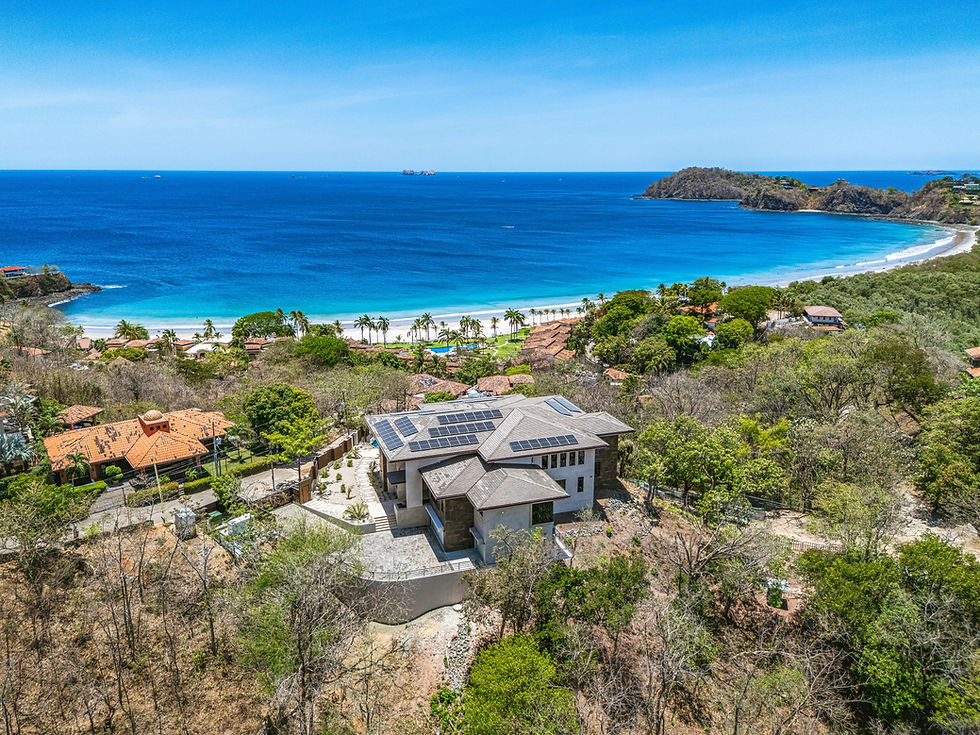
Guanacaste has some extraordinary ocean-view real estate.
The geography creates hillside communities where homes can look across bays, peninsulas and the open Pacific. In areas around Playas del Coco, Playa Hermosa and Ocotal, an exceptional view can materially influence property value.
But I want buyers to look at the land below the view as carefully as the ocean beyond it.
Is it developed?
If not, can it be developed?
What are the building restrictions?
How tall could a future structure be?
Who controls vegetation?
Is the view protected by elevation and topography, or does it depend on the vacant lot immediately below?
The difference is important.
Buyers sometimes treat a view as though it were part of the title.
Usually, it isn't.
The house belongs to you.
The horizon does not.
A well-positioned home with a genuinely difficult-to-obstruct view can therefore deserve a significant premium.
Scarcity has value.
Visit the Road, Not Just the House
If there is one piece of advice that sounds trivial until you live here, it is this:
Pay attention to the road.
A spectacular home fifteen minutes from town may be a wonderful purchase.
But fifteen minutes on pavement is not the same as fifteen minutes on steep or difficult access.
This matters for everyday life.
It matters for guests.
It matters for vacation rentals.
And it matters when you eventually sell.
Foreign buyers sometimes underestimate convenience because they are evaluating the property while on vacation.
Driving twenty minutes to dinner feels charming for ten days.
Doing it twice a day for ten years can feel different.
The strongest locations often combine enough privacy to feel tropical with enough accessibility to make ordinary life easy.
That balance is one reason established communities around Playas del Coco real estate remain attractive to foreign buyers. The beach matters, but so do supermarkets, restaurants, pharmacies, medical services and relatively quick access to Guanacaste Airport.
Convenience does not photograph as beautifully as an infinity pool.
It ages extremely well.
Rainy Season Is Not a Footnote
Many international buyers first experience Guanacaste between December and April.
It is easy to understand why they fall in love.
The days are sunny. The hills are dry and golden. Rain becomes something people vaguely remember.
Then May arrives.
And Costa Rica transforms.
The hills turn green with astonishing speed. Tropical vegetation returns. Afternoon storms become part of the landscape.
Personally, I think this season reveals some of Guanacaste's greatest beauty.
It also reveals houses.
Where does rainwater go?
How does the driveway behave?
Is drainage properly designed?
Does the house ventilate well?
How does the property handle humidity?
What happens to the view when vegetation grows?
A property that works well during rainy season has passed a test that no January showing can provide.
This is especially important with hillside homes.
Beautiful topography creates beautiful views.
It also makes drainage and retaining structures important.
I would rather discover how those systems function before buying than during the first major storm afterward.
Rental Income Is Real. So Are Rental Expenses.
Vacation rental income has become an important part of Costa Rica investment property.
And in the right location, with the right property and good management, it can be substantial.
But there is a difference between a home that can be rented and a home that performs as a rental investment.
Travelers are increasingly sophisticated.
They compare photography, amenities, reviews, location, design and price within seconds.
A successful rental therefore needs more than bedrooms and proximity to the beach.
It needs presentation.
Management.
Maintenance.
Responsive communication.
Pricing.
Cleaning.
Reliable internet.
Good mattresses.
Enough towels.
Working air conditioning.
And the hundred small details guests barely notice when everything goes correctly.
Those things cost money.
So when a seller says a property "rents for $500 per night," I want to know what happened over the entire year.
What was the average realized nightly rate?
How many nights were occupied?
What was gross revenue?
How much did management cost?
What did the owner spend maintaining the property?
How many prime weeks did the owner personally use?
Gross revenue makes attractive marketing.
Net income makes an investment.
Property Management Is More Important Than Many Buyers Expect
For buyers who intend to live here full-time, local ownership becomes relatively straightforward. You see the house every day.
Second-home owners have a different challenge.
Costa Rica's climate does not pause because you flew back to Toronto.
A leaking pipe does not wait.
An air conditioner can fail.
Heavy rain can reveal drainage problems.
Internet can go down.
A tree can fall.
A refrigerator can stop working in an empty house.
Someone needs to know.
This is why reliable Costa Rica property management can be one of the most valuable relationships an absentee owner develops.
For rental properties, management becomes even more important.
The manager is not merely taking reservations.
They are protecting the reputation of an income-producing asset.
The cheapest manager is not necessarily the least expensive manager.
That distinction becomes clearer after the first year.
The HOA Fee Is Not the Number You Should Be Afraid Of
Foreign buyers frequently dislike HOA fees on principle.
I understand the reaction.
Nobody enjoys adding another recurring expense.
But I have learned to look at HOA fees differently.
A healthy HOA may be paying for security, landscaping, roads, common pools, insurance, infrastructure and reserves.
A low HOA may simply mean owners are paying those expenses individually.
Or worse, that nobody is adequately funding them.
So instead of asking whether the HOA is expensive, ask whether it is well run.
What does the fee include?
How much money is held in reserves?
Are major repairs planned?
Are there owners who are significantly behind on payments?
Have special assessments been common?
What are the rental rules?
The financial health of a community becomes part of the value of every property inside it.
A beautiful condominium in a poorly managed association can become frustrating.
An expensive HOA in an exceptionally well-managed community can make foreign ownership remarkably easy.
Your Attorney Should Be Independent
This is one place where I want foreign buyers to be unequivocal.
Have your own qualified Costa Rican attorney review the transaction.
The attorney's job is not to sell you the property.
Their job is to represent your legal interests.
They should review title, registered liens and encumbrances, corporate matters where applicable, the cadastral plan, relevant documentation and the structure of the transaction.
If the property is unusual - beachfront, development land, a corporate share transfer or anything involving unclear access or construction questions - the legal investigation should become correspondingly more detailed.
A good attorney occasionally makes a transaction feel slower.
That is not necessarily a problem.
When hundreds of thousands or millions of dollars are moving between countries, a little boredom is healthy.
Resale Begins on the Day You Buy
Buyers rarely want to discuss selling the property they have not yet purchased.
I understand.
But I ask them to think about it anyway.
Who is the next buyer?
If circumstances change five years from now, what will make somebody choose this property?
Is it walkable?
Does it have an exceptional view?
Is the HOA manageable?
Does it rent well?
Is the floor plan practical?
Is the community established?
Is access easy?
Is there something about the property that cannot easily be reproduced?
The strongest real estate often has more than one reason to own it.
It works as a residence.
It works as a vacation home.
It may work as a rental.
And when the owner eventually wants to sell, it appeals to another group of buyers.
Flexibility creates liquidity.
This is particularly important in a market dominated partly by international purchasers. A very unusual property may be extraordinary, but the buyer pool for extraordinary properties can be narrow.
There is nothing wrong with buying something unique.
Just understand that uniqueness cuts both ways.
Don't Buy the Life You Have on Vacation
Perhaps the most important lesson has nothing to do with property law or economics.
Buy the property for the life you will actually live.
People behave differently on vacation.
They drive farther for dinner.
They tolerate inconvenience.
They spend entire afternoons beside the pool.
They do not care that the supermarket is twenty-five minutes away because they are only going twice.
Then they move.
Suddenly, the things that seemed mundane become important.
Where is the pharmacy?
Can I walk anywhere?
How long does it take to reach the airport?
Where will my children go to school?
Where is the nearest medical clinic?
Can I meet people?
What will I do on an ordinary Wednesday in September?
This is why I hesitate when someone says they want "total privacy" before they have spent meaningful time living here.
Privacy is wonderful.
Isolation is different.
The correct amount varies enormously from person to person.
Costa Rica Rewards Buyers Who Slow Down
There is a contradiction at the heart of buying real estate in Costa Rica.
The country encourages you to slow down.
The property market sometimes makes you feel you need to hurry.
A desirable house appears.
Another buyer is interested.
Flights home are approaching.
Suddenly, a decision involving half a million dollars feels as though it must be made by Friday.
Sometimes speed is necessary.
Panic rarely is.
A serious buyer can move efficiently while still insisting on due diligence.
Those are not opposing ideas.
If the property is right, understanding it more deeply should strengthen the decision.
And if understanding it causes the decision to collapse, the investigation probably did its job.
What I Wish Every Buyer Knew
If I could sit down with every foreigner before they began searching for Costa Rica homes for sale, I would tell them something surprisingly simple.
Don't search only for a beautiful property.
Search for a property that will be easy to love five years from now.
That means understanding the unphotogenic things.
The title.
The road.
The HOA.
The water.
The maintenance.
The rainy season.
The rental economics.
The neighbors.
The resale market.
And your own life.
Costa Rica does not need to be sold particularly hard. Spend enough time here and the country usually makes its own argument.
The warm evenings.
The landscape.
The wildlife.
The relative informality of daily life.
The ability to finish work and be in the ocean fifteen minutes later.
Those things are real.
But real estate is where the dream becomes permanent.
And permanence deserves a different standard than vacation.
The best buyers allow themselves to fall in love with Costa Rica.
They simply don't let falling in love prevent them from asking questions.
Because the goal is not merely to find a house that makes you say wow when the front door opens.
It is to find one that, years later, still makes you think:
I'm glad this is the one I bought.
Buying or Selling in Costa Rica?
Let me help you with the process! Get in touch at Whatsapp +506 8713 8080 or sabina@palmrealestatecr.com


Comments