The Ultimate Due Diligence Guide to Buying Property in Costa Rica: What Foreign Buyers Should Know Before Closing

There is a moment in almost every Costa Rican real estate transaction when the property begins to look very different.
It usually happens shortly after the offer is accepted.
Until then, the experience has been overwhelmingly visual. Buyers have walked through kitchens, opened sliding glass doors and stood on terraces overlooking the Pacific. They have compared swimming pools and neighborhoods, measured the distance to the beach and imagined where visiting children or grandchildren might sleep.

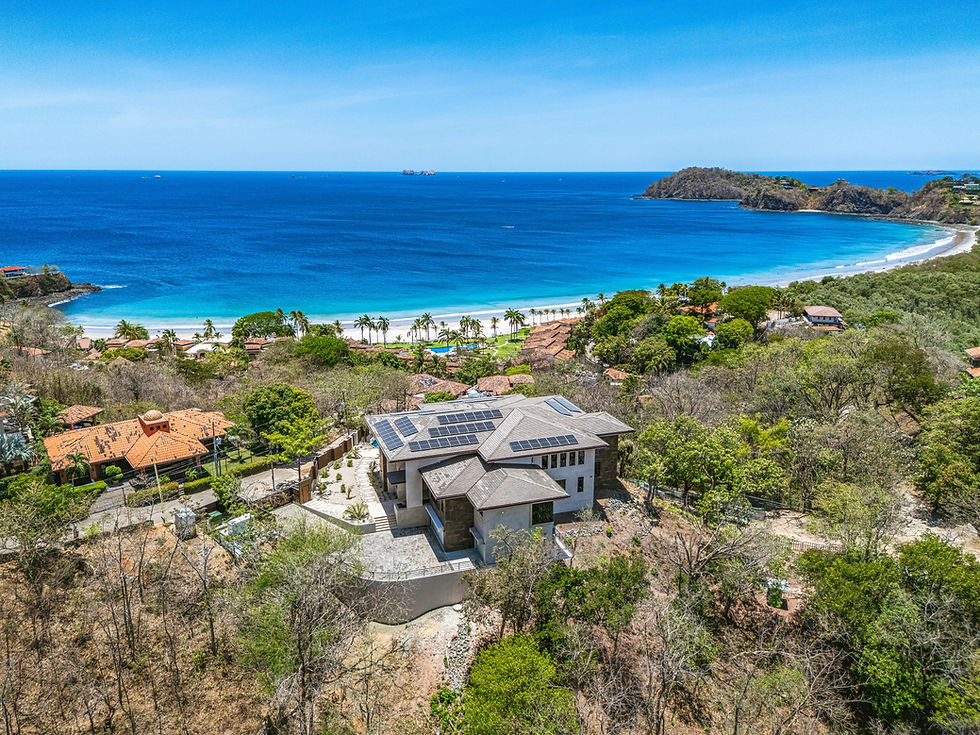
In Guanacaste, particularly, a showing can be remarkably persuasive. The dry-season sky is blue. The doors are open. The swimming pool reflects the afternoon light. Somewhere beyond the terrace, the Pacific occupies half the horizon.
Then the purchase agreement is signed.
Suddenly, the conversation turns to cadastral plans, easements, water availability, corporate ownership, municipal permits and condominium bylaws.
The house has not changed.
But the buyer's understanding of it is about to.
This period, generally referred to as due diligence, may be the least glamorous part of buying property in Costa Rica. It is also one of the most consequential.
For foreign buyers accustomed to the highly standardized residential markets of the United States or Canada, Costa Rica can require a change in mindset. The country has a formal property registration system, and foreigners can generally own titled real estate with the same ownership rights as Costa Rican citizens. But that does not mean every property is identical from a legal, physical or practical standpoint.
A beautiful home may have a perfectly clean title but a complicated access arrangement. A spectacular parcel of land may turn out to have limitations on what can actually be built there. A condominium may look impeccably maintained while its association is preparing for an expensive capital project. A beachfront property may operate under a completely different legal framework from a titled home several hundred meters inland.
None of these possibilities should frighten a serious buyer.
They should make that buyer curious.
Because due diligence is not primarily about finding reasons not to purchase a property. It is about discovering exactly what you are purchasing before the money changes hands.
The House You See and the Property You Buy
One of the most useful ways to understand Costa Rican real estate is to think of a property as having several identities.
There is the physical property.
That is the version buyers encounter first: the house, the land, the pool, the view, the furniture and the landscaping.
Then there is the legal property.
That version exists in the National Registry. It has an owner, a registered area, a cadastral plan and, potentially, mortgages, liens, easements or other annotations associated with it.
Finally, there is what might be called the permitted property: what has legally been constructed, what the land can be used for and what may be built or altered in the future.
A well-structured transaction tries to determine whether those versions of the property tell the same story.
Most of the time, they do.
When they don't, the differences deserve attention.
This is why experienced buyers do not begin due diligence with the swimming pool or the appliances.
They begin with ownership.
Who, Exactly, Is Selling You the Property?
The question sounds almost absurdly simple.
Who owns the house?
Yet it is the foundation on which the entire transaction rests.
Costa Rica's National Registry records ownership of titled real estate, together with information affecting the property. A buyer's independent attorney can review the registered title, determine who owns it and identify registered mortgages, liens, easements and other relevant annotations.
Sometimes the registered owner is an individual.
Often, particularly in transactions involving foreign owners, the property belongs to a Costa Rican corporation.
That is not inherently unusual or problematic. But it adds another layer of inquiry. The attorney needs to understand the corporate structure, who has authority to act for the company and whether the transaction involves transferring the property itself or, in some cases, shares of the entity that owns it.
These distinctions may sound remote from the experience of buying a beach house.
They stop feeling remote the moment something is unclear.
Good due diligence is often remarkably boring. The owner is who everyone said the owner was. The documents correspond. The corporate records are in order.
Boring, in this context, is excellent.
A Fence Is Not a Survey
The next surprise for some foreign buyers comes when they begin looking at the land itself.
Walk around a property and its boundaries often appear self-evident. There may be a wall along one side, a hedge on another and a driveway leading to the road. The garden appears to end where the neighboring garden begins.
But landscaping is not a legal boundary.
Neither is a fence.
Costa Rican titled properties generally have a registered cadastral plan, commonly called a plano catastrado, identifying the parcel.
For a straightforward condominium purchase, this may be relatively uneventful. For a freestanding home, large lot or development property, the relationship between the survey and what exists physically deserves closer attention.
Where exactly are the boundaries?
Does the registered area correspond with what is being marketed?
How does the property reach the public road?
Are there easements?
Does a driveway cross another property?
Are structures positioned where everyone assumes they are?
These questions become especially important with larger properties.
A buyer purchasing 10,000 square meters is not merely buying an impressive number on a listing. The shape, access, topography and legal configuration of those 10,000 square meters can determine whether the land is exceptionally useful or surprisingly constrained.
In Guanacaste, Ask About Water Before You Ask About the Pool
There are parts of the world where water is such an ordinary utility that buyers rarely discuss it until they receive their first bill.
Guanacaste is not one of those places.
Water has played an important role in development throughout the province, particularly when it comes to new construction. A serious buyer of land should therefore resist vague assurances that a property "has water" without understanding precisely what that means.
An existing home with an established legal water connection presents a very different situation from an undeveloped parcel being purchased for future construction.
If the plan is to build, the question is not simply whether water exists somewhere nearby.
The relevant questions are more specific.
Who is the provider? Is there an existing connection? What documentation exists? Does the proposed project require additional approvals or availability? If the buyer envisions multiple residences, will the infrastructure support that use?
This is one of the areas where the buyer's intended use becomes critical.
A parcel may be perfectly suitable for one home and unsuitable for the five-unit project a buyer imagined when first standing on it.
The land has not become less valuable.
The buyer has simply discovered what kind of land it actually is.
The Dangerous Simplicity of "You Can Build Here"
Vacant land encourages imagination.
A hillside overlooking the Pacific can become almost anything in a buyer's mind.
A contemporary villa.
Three rental homes.
A family compound.
A boutique hotel.
Perhaps all of them.
It is very easy, while standing on an empty lot, to confuse physical space with development potential.
They are not the same thing.
Before paying a price based on what a property might become, a buyer needs to understand what can actually be approved there.
Land use, access, water, wastewater treatment, setbacks, road requirements, topography and environmental considerations can all influence development.
This does not mean building in Costa Rica is impossibly complicated. Homes and developments are constructed throughout Guanacaste every year.
It means the time to investigate a development idea is before purchasing the land on which the idea depends.
A buyer who wants a private residence should investigate the property as a future private residence.
A buyer planning six rental units should investigate it as a six-unit development.
Due diligence should follow the business plan, not merely the property description.
Existing Houses Have Histories Too
Completed homes present the opposite psychological problem.
Because the house is already standing, it feels settled.
A buyer walks through a four-bedroom villa and naturally assumes they are buying a legally documented four-bedroom villa.
Usually that assumption is correct.
But Costa Rica has plenty of homes that have evolved over time.
A terrace may have been enclosed. A guest bedroom added. A pool constructed years after the original house. A garage converted into living space. An outdoor kitchen built beside the terrace.
Many such improvements are beautifully executed.
The due diligence question is whether significant improvements were appropriately permitted and reflected in the relevant records where required.
This matters less because someone is likely to appear immediately after closing and object to the outdoor kitchen, and more because irregularities have a tendency to reappear at inconvenient moments.
During a future renovation.
During a financing process.
During resale.
The buyer who ignores an unresolved issue may simply become the seller who eventually has to solve it.
The Ocean Changes the Legal Conversation
Few subjects deserve more careful treatment than beachfront property.
Foreign buyers often arrive in Costa Rica having heard two apparently contradictory statements.
"Foreigners can own property in Costa Rica."
And:
"Foreigners can't own beachfront property."
Neither statement, without context, tells the complete story.
Foreigners can generally own titled Costa Rican real estate. But land within Costa Rica's Maritime-Terrestrial Zone, or Zona Marítimo Terrestre, can be governed by a different legal regime.
In general terms, the maritime zone extends 200 meters inland from the ordinary high-tide line, with the first 50 meters forming public land and much of the following 150 meters potentially subject to concession rules rather than ordinary titled ownership.
There are exceptions and historically titled properties, which is precisely why buyers should not make assumptions based solely on proximity to the ocean.
A house marketed as "beachfront" tells you where it is.
It does not tell you how it is legally held.
For a foreign buyer, that distinction can be enormously important.
This is an area where qualified independent legal advice is essential.
What the HOA Fee Doesn't Tell You
The rise of professionally managed communities has transformed the foreign-buyer experience in Guanacaste.
For someone who spends only part of the year in Costa Rica, a well-run condominium or gated development can solve numerous practical problems. Security, landscaping, roads, swimming pools and common facilities may all be managed collectively.
The buyer receives convenience.
The buyer also acquires obligations.
This is why asking only for the monthly HOA fee is not enough.
A $500 monthly fee may be excellent value in one development and inadequate in another.
The more interesting questions concern what lies behind the number.
What does the fee cover?
Does the association maintain adequate reserves?
Are there significant owners in arrears?
Are major repairs anticipated?
Have special assessments been common?
What are the rules governing rentals?
Are there restrictions on pets, renovations or commercial activity?
How is the association governed?
A beautifully maintained pool can tell you what the community looks like today.
The financial statements can help tell you what it may look like five years from now.
This becomes especially important for buyers purchasing Costa Rica investment property.
If the economic logic of the purchase depends on short-term rentals, discovering restrictive rental rules after closing is not a minor inconvenience. It changes the investment.
Then, Finally, Inspect the House
Only after all of this do we arrive at the part many buyers originally thought was due diligence: the home inspection.
It remains enormously important.
Costa Rica's climate asks a great deal of buildings, particularly near the coast.
The combination of humidity, intense sunlight, seasonal rainfall and salt air can accelerate wear. Air-conditioning systems work hard. Metal corrodes. Exterior finishes age. Water intrusion that would be unusual elsewhere can become a serious issue if drainage and waterproofing were poorly designed.
Hillside properties introduce another dimension.
A villa may owe its extraordinary view to the same slope that required retaining structures, extensive drainage and engineered foundations.
Those systems are easy to ignore because they are not what buyers came to see.
Nobody falls in love with a retaining wall.
But replacing one can cost considerably more than replacing a kitchen.
A good inspection therefore looks beyond cosmetic finishes and asks how the property functions as a building in a tropical environment.
September Can Tell You More Than February
One of the best things a buyer can do, when circumstances allow, is to see the property under less flattering conditions.
Guanacaste during the dry season is a formidable salesperson.
The roads are dry. The sky can remain cloudless for days. Hillsides turn golden. The Pacific seems to sit permanently beneath blue light.
Rainy season asks different questions.
Where does the water go?
How does the driveway perform?
Does the road flood?
Does water collect near retaining walls?
How humid does the interior become?
How aggressively does vegetation grow?
Does that panoramic ocean view remain panoramic?
None of this makes rainy season a negative. Many residents consider the green months among the most beautiful times of the year.
But a property that functions well in September has proved something a February showing cannot demonstrate.
It has shown you how it behaves.
When a Rental Property Is Really a Small Business
The vacation rental boom has added another category of due diligence.
Financial history.
A buyer may be told that a villa rents for $600 a night.
That number is almost meaningless on its own.
For how many nights?
During which months?
At what average realized rate?
After what management fee?
With how much owner occupancy?
What were the utility costs?
How much was spent on repairs?
Was the property recently renovated?
Are the online reviews attached to the property, the manager or an account that may not transfer?
The distinction between gross revenue and net income is particularly important.
A home producing $120,000 in annual gross bookings can sound like a remarkable investment until the buyer understands what it costs to produce those bookings.
Conversely, a property with modest historical income may have significant upside if the previous owner occupied it for months each year or never marketed it professionally.
The objective is not to accept or reject the seller's rental story.
It is to understand it.
What Due Diligence Is Really For
By this point, foreign buyers sometimes begin to wonder whether the entire process is designed to make them nervous.
It isn't.
Due diligence is not a hunt for defects.
It is a process of replacing assumptions with facts.
Sometimes those facts reveal a problem serious enough to reconsider the purchase.
More commonly, they reveal ordinary imperfections.
An air-conditioning unit is nearing the end of its life.
A condominium has an upcoming assessment.
A survey needs clarification.
A renovation requires additional documentation.
A rental projection was overly optimistic.
These findings do not necessarily destroy a transaction.
They can influence negotiations. They can change budgets. They can lead to conditions being resolved before closing.
Most importantly, they allow the buyer to make the decision with open eyes.
The Best Due Diligence Is Almost Disappointingly Boring
There is a paradox at the heart of international real estate.
The purchase itself feels adventurous.
The legal process should not.
The ideal due diligence period ends without a dramatic discovery.
The registered owner is correct.
The title is clear.
The survey makes sense.
Access is established.
Water is documented.
The improvements are in order.
The HOA is functioning.
The inspection reveals manageable maintenance.
The numbers correspond reasonably with what the buyer was told.
By closing day, the property should feel less mysterious than it did when the offer was written.
That is progress.
Before You Wire the Money
When buyers reach the end of due diligence, I think there is one question more useful than almost any other:
Do you now understand what you are buying?
Not simply whether you still love it.
Do you understand its legal status?
Its boundaries?
Its physical condition?
Its annual costs?
Its community obligations?
Its water situation?
Its rental restrictions?
Its vulnerabilities?
Its possibilities?
If the answer is yes, then the decision becomes considerably clearer.
Costa Rica real estate continues to offer something relatively unusual: the possibility of combining lifestyle, investment and international ownership in a country that has attracted foreign residents and investors for decades.
But beautiful markets can encourage people to move quickly.
And the more desirable the property feels, the more tempting it becomes to treat investigation as an obstacle standing between the buyer and the keys.
It is better understood as the opposite.
Due diligence is what allows you to enjoy those keys after they are yours.
The terrace will still be there.
The Pacific will still be there.
The pool will look exactly as inviting as it did the first afternoon.
The difference is that now, when you stand there, you know what lies behind the view.
And you know that it belongs to you.


Comments