How to Know If a Property in Costa Rica Is Overpriced: What Foreign Buyers Should Check Before Making an Offer when buying Costa Rica Real Estate

There is a peculiar moment that occurs during many real estate searches in Costa Rica.
A buyer opens two listings.
Both are three-bedroom homes. Both have pools. Both are within fifteen minutes of the beach. One is listed for $695,000. The other is $1.15 million.
The natural question is immediate.
Why?
In Miami, Toronto, Vancouver or many other mature real estate markets, the buyer might pull up recent sales in the building or neighborhood and arrive at a reasonably informed answer within minutes. Price per square foot, tax history and comparable transactions create a framework against which a listing can be measured.
Costa Rica is different.
There is no national equivalent of the MLS system familiar to many North American buyers that provides the public with a complete, standardized history of recent transactions. Properties may be marketed through multiple agencies. Recorded values do not necessarily tell you what a property would command on the open market. And in coastal communities, where no two hillsides, roads or ocean views are quite identical, even apparently comparable homes can be surprisingly difficult to compare.
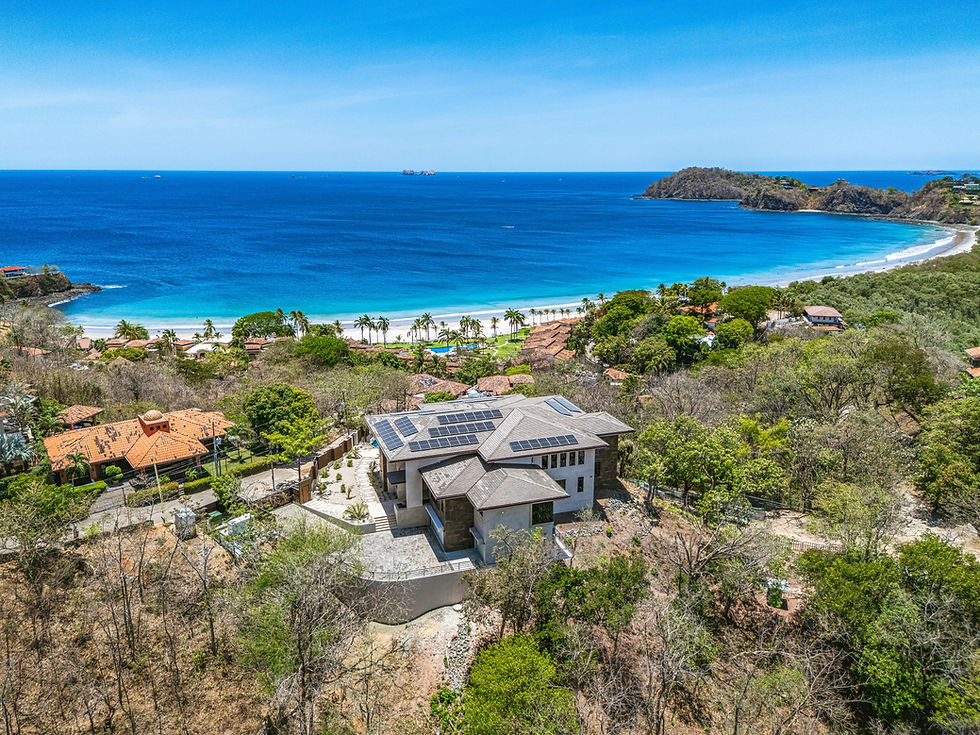
That ambiguity creates one of the most important questions facing anyone buying property in Costa Rica:
How do you know what a property is actually worth?
After years of working with buyers, I have come to believe that this question matters considerably more than whether someone negotiates another $10,000 or $20,000 off the purchase price.
A discount on the wrong property is still the wrong property.
And a property that initially appears expensive can sometimes prove to be the better purchase.
The challenge is learning to distinguish between the two.
Costa Rica Is Not One Real Estate Market
The first mistake is talking about "the Costa Rica real estate market" as though it were a single market.
It isn't.
Costa Rica is better understood as a collection of very small real estate markets, sometimes separated by only a few kilometers.
A home in Playas del Coco behaves differently from a home in Playa Hermosa. A condominium in central Coco belongs to a different market from a villa overlooking the bay. A property within an established gated community can have a different buyer pool from a visually similar house on an independent hillside.
The same is true farther down the Guanacaste coast.
Flamingo, Tamarindo, Papagayo and surrounding communities each have their own supply constraints, buyer demographics and pricing behavior.
This fragmentation is becoming particularly important as Guanacaste matures. Recent reporting on the region describes international buyers, global hospitality brands, improved air access and a more developed service infrastructure continuing to reshape the province. Liberia's international airport currently receives flights from 26 origins in the United States, Canada and Switzerland, according to figures reported from airport operator CORIPORT.
The result is not that every property in Guanacaste automatically becomes more valuable.
It is that buyers need to become more precise.
And increasingly, they are.
The Asking Price Is a Conversation, Not a Valuation
This sounds obvious, yet it is surprisingly easy to forget when looking at beautiful houses.
A listing price is what a seller would like to receive.
It is not an independent appraisal of market value.
Sometimes the two numbers are close. Sometimes they are not.
A seller may have chosen the price because a neighbor listed at a similar level. Another may be trying to recover the cost of an expensive renovation. Someone else may simply have a number in mind below which they have no interest in selling.
None of those considerations necessarily establishes market value.
This is particularly important in a market with many discretionary sellers.
An owner who does not need to sell can test an ambitious price for months or even years. The existence of that listing can then influence other sellers, creating the appearance of a new market level without a transaction ever having taken place.
Foreign buyers should therefore resist a very common psychological shortcut:
"Everything I see listed around $900,000 must mean these homes are worth around $900,000."
Perhaps.
But the better question is:
What has a buyer actually been willing to pay for something comparable?
That distinction is fundamental.
Comparable Sales Matter - But the Word "Comparable" Does a Lot of Work
A competent analysis begins with recent transactions.
But simply finding another three-bedroom house is not enough.
In coastal Costa Rica, I would want to know considerably more.
How far is it from the beach?
Is the road paved?
How steep is the access?
Is there reliable water?
Is the property in a recognized community?
Is there security?
How old is the construction?
What condition is the roof in?
How recently were the air-conditioning systems replaced?
Does it have a genuinely panoramic ocean view or a narrow glimpse of water?
Can something be constructed in front of that view?
Can a visitor comfortably reach the house without a four-wheel-drive vehicle?
Is it fifteen minutes from restaurants because the road is easy, or fifteen minutes on a road that becomes a completely different experience after heavy rain?
These details sound mundane beside photographs of infinity pools.
They are also precisely the details that determine value.
The View May Be Worth More Than the Extra Bedroom
Foreign buyers often begin by comparing houses the way they would at home: bedrooms, bathrooms and square footage.
Along the Guanacaste coast, that can be misleading.
A beautifully positioned three-bedroom home can command more than a larger four-bedroom property because the smaller house occupies something that cannot easily be reproduced: an exceptional piece of land.
A protected Pacific view is finite.
So is walkability to the beach.
So is a genuinely good location inside an established community.
Bedrooms can be remodeled. Kitchens can be replaced. Furniture can be upgraded.
Location cannot.
This is one reason luxury coastal property can appear irrational when judged strictly by construction cost.
A buyer is purchasing two things simultaneously: the building and the position it occupies.
Over a long enough period, the second can become considerably more important than the first.
Look Down the Hill Before You Pay for the View
There is another question I encourage buyers of ocean-view property in Costa Rica to ask.
What do you not own?
Specifically, what lies between your terrace and the ocean?
A magnificent view across an empty parcel may feel permanent. But if that parcel is separately owned and buildable, you are not necessarily buying the view you see today. You are buying a view subject to whatever can legally happen below you tomorrow.
That does not automatically make the property a bad investment.
It changes what the view should be worth.
This is where HOA restrictions, zoning, topography and neighboring lots deserve much more attention than they usually receive.
The spectacular photograph gets the buyer through the door.
The land below the photograph may determine whether the premium remains justified ten years later.
Then Drive the Road in the Rain
A property's value is not confined to its property line.
One of the easiest ways to overpay in Costa Rica is to value the house while ignoring the journey required to reach it.
The difference between paved, easy access and a steep, difficult road can influence everything from daily convenience to vacation-rental demand and eventual resale.
A secluded villa may photograph beautifully. It may also mean twenty additional minutes every time an owner wants groceries, dinner or medical care.
That inconvenience tends to be discounted during a one-week vacation.
It becomes considerably more important after six months of living there.
Infrastructure is one reason established coastal corridors continue attracting foreign investment. Guanacaste's airport connectivity, hospitality investment and expanding services have helped turn the region from primarily a vacation destination into a much more mature ownership market.
But even within that growth corridor, convenience commands a premium.
Often, it deserves one.
HOA Fees Can Change What "Cheap" Means
Suppose two condominiums each cost $400,000.
The first has an HOA fee of $250 a month.
The second charges $750.
The difference is $6,000 annually.
Over ten years, ignoring increases and the time value of money, that is $60,000.
Suddenly, the purchase prices are not as similar as they appeared.
This does not mean the higher HOA is bad. A professionally managed community with security, beautiful common areas, well-maintained infrastructure and valuable amenities may justify every dollar.
The issue is value.
What are you receiving?
How healthy are the association's reserves?
Are major repairs approaching?
Have there been special assessments?
Are owners paying their dues?
A low HOA can occasionally be more concerning than a high one if the community is postponing necessary maintenance.
Experienced buyers therefore don't simply ask, "How much is the HOA?"
They ask, "What does the HOA tell me about this property's future?"
Rental Income Can Expose an Inflated Price
For an investment property, rental performance provides another useful reality check.
Imagine two condos listed for $450,000.
One has demonstrated rental demand, excellent reviews, professional management and a history of strong occupancy.
The other has a beautiful furniture package and an optimistic projection.
Those are not equivalent investments.
If rental income is part of the reason you are buying, request evidence whenever possible.
Look at actual historical performance rather than simply taking a peak nightly rate and multiplying it by 365.
A $400-per-night villa is not a $146,000-per-year business if it is occupied only part of the year.
The number that matters is net operating performance after management, utilities, HOA, maintenance, insurance, taxes, replacements and other costs.
This is particularly relevant in 2026 because foreign buyers appear to be becoming more selective. Current market commentary describes buyers paying greater attention to carrying costs, legal clarity, infrastructure and year-round usability rather than purchasing on lifestyle appeal alone.
That is a healthy development.
Beautiful property attracts attention.
Good economics sustain value.
The Most Important Comparable Is the Future Buyer
There is a question I wish more buyers asked before closing:
Who will buy this property from me?
Not because they should already be planning to leave Costa Rica.
Because circumstances change.
People relocate. Families grow. Retirement plans evolve. Investments are rebalanced.
A property with a clear future buyer is fundamentally safer than one whose appeal depends on a very specific person wanting a very specific lifestyle.
Consider two homes.
One is ten minutes from the airport corridor, near restaurants, beaches and medical services, with an attractive view and manageable carrying costs.
The other is spectacular but remote, expensive to maintain and difficult to access.
The second might be the more extraordinary home.
The first may have the stronger resale market.
Neither is automatically better. But they represent different kinds of risk.
This is what sophisticated buyers eventually understand: resale begins at purchase.
Be Careful With "New"
New construction deserves its own discussion.
There is something psychologically reassuring about being the first person to occupy a property. New finishes, contemporary architecture and pristine kitchens command attention, particularly from international buyers.
But "new" is not the same as "correctly priced."
When evaluating pre-construction or newly completed property, I would look carefully at the developer's track record, infrastructure, delivery history, specifications and the supply of similar units planned for the future.
If 100 nearly identical condos are delivered around the same time, your eventual resale property may compete with dozens of others.
Scarcity matters.
The most valuable real estate usually possesses something that cannot simply be duplicated in the next phase.
A location.
A view.
A larger terrace.
A corner position.
Walkability.
Exceptional architecture.
A particularly good lot.
Buy uniqueness when you can.
Legal Clarity Has Economic Value
Foreigners can generally purchase titled property in Costa Rica without becoming residents, but the country's coastal maritime-zone rules create an important exception that requires careful legal review.
Buyers naturally think of due diligence as protection against legal problems.
It is also part of valuation.
A clean title, accurate survey, legal access, proper permits and clear ownership history make a property easier to finance, easier to insure, easier to improve and eventually easier to sell.
Legal clarity is not glamorous.
Neither is drainage.
Neither is water availability.
But these are exactly the characteristics that become enormously valuable when something goes wrong.
A property should not receive a premium merely because its problems have not yet become visible.
When Paying More Can Actually Be the Smarter Decision
Perhaps the most counterintuitive lesson in real estate is that avoiding overpayment does not necessarily mean buying cheaply.
I have seen buyers become so focused on finding a bargain that they overlook better properties because they seem expensive.
Suppose one home is $100,000 cheaper but needs significant renovations, sits on a difficult road and has limited resale appeal.
Another costs more but occupies an excellent lot in an established community, has reliable infrastructure and can be rented or resold to a broad international market.
Which is expensive?
The answer may not be obvious for five years.
Real estate value reveals itself over time.
The property that is easiest to buy is not always the property that is easiest to own.
And the property that is cheapest to buy is certainly not always the cheapest to own.
What I Would Want to Know Before Making an Offer
By the time a buyer is ready to write an offer on Costa Rica real estate, I want the romance of the property to survive a much less romantic conversation.
What have comparable properties actually sold for?
How long has this one been on the market?
Has the price changed?
What are the annual carrying costs?
What is the condition of the expensive systems?
What can be built nearby?
How reliable is access in September?
What does the HOA have in reserves?
If it is a rental, what did it actually earn?
Is the water situation clear?
Are the improvements properly documented?
And ultimately:
If we needed to put this property back on the market five years from now, what would make the next buyer choose it?
If those questions have good answers, paying a strong price does not frighten me nearly as much.
If they don't, a discount doesn't necessarily make me comfortable.
The Market Is Maturing - And Buyers Should Too
Guanacaste today is not the Guanacaste of twenty years ago.
International connectivity has expanded. Luxury hospitality has moved decisively into the region. Infrastructure has improved. New developments are arriving, and global buyers are paying attention. Recent industry reporting points specifically to branded residences, marina infrastructure, air access and a more mature service ecosystem as forces reshaping the Pacific coast.
That growth creates opportunity.
It also requires more sophisticated buying.
The era in which almost any well-located coastal property could be treated as an obvious bargain is fading. As markets mature, quality becomes more important. So does price discipline.
And that may ultimately be good for everyone.
Serious buyers begin asking better questions.
Good properties separate themselves from mediocre ones.
And value becomes less about what someone hopes a property is worth and more about what makes it genuinely difficult to replace.
The Question Behind the Price
When foreign buyers ask me whether a property is overpriced, they are often hoping for a simple answer.
Sometimes there is one.
Often there isn't.
Real estate is not a supermarket shelf where two identical products can be compared by price.
Particularly in Costa Rica, value lives in the details: the road, the view, the water, the neighborhood, the title, the management, the carrying costs, the rental history and the buyer who may someday stand where you are standing now.
So before asking whether you can negotiate $50,000 off the asking price, ask something more important:
If I owned this property for the next ten years, would I still be glad I bought this particular one?
That is a harder question.
It is also much closer to the definition of a good investment.


Comments